Izotope Rx 6 Student
May 22, 2017 We had a visit from the folks at iZotope who showed us the new features in RX 6 - the latest version of their audio restoration toolkit. Check our Awesome MA.
- Izotope Rx Manual
- Izotope Rx 2 Free Download
- Izotope Rx 6 Advanced Manual
- Izotope Rx 6 Torrent
- Izotope Rx 6 Audio Editor
- Izotope Rx Tutorial
- Izotope Rx 6 Student Login
RX Advanced is iZotope’s flagship audio-correction/fixing application. A couple of versions ago, the app became a true editor with the ability to record and edit audio and to fix, correct and adjust using sophisticated machine learning algorithms. As with all technology, the app continuously evolves and improves, and the latest version, RX 7 Advanced, is now capable of intelligently identifying vocals, bass, percussion and other instruments in a mix. In addition, RX 7 Advanced now also supports surround sound.
Izotope Rx Manual

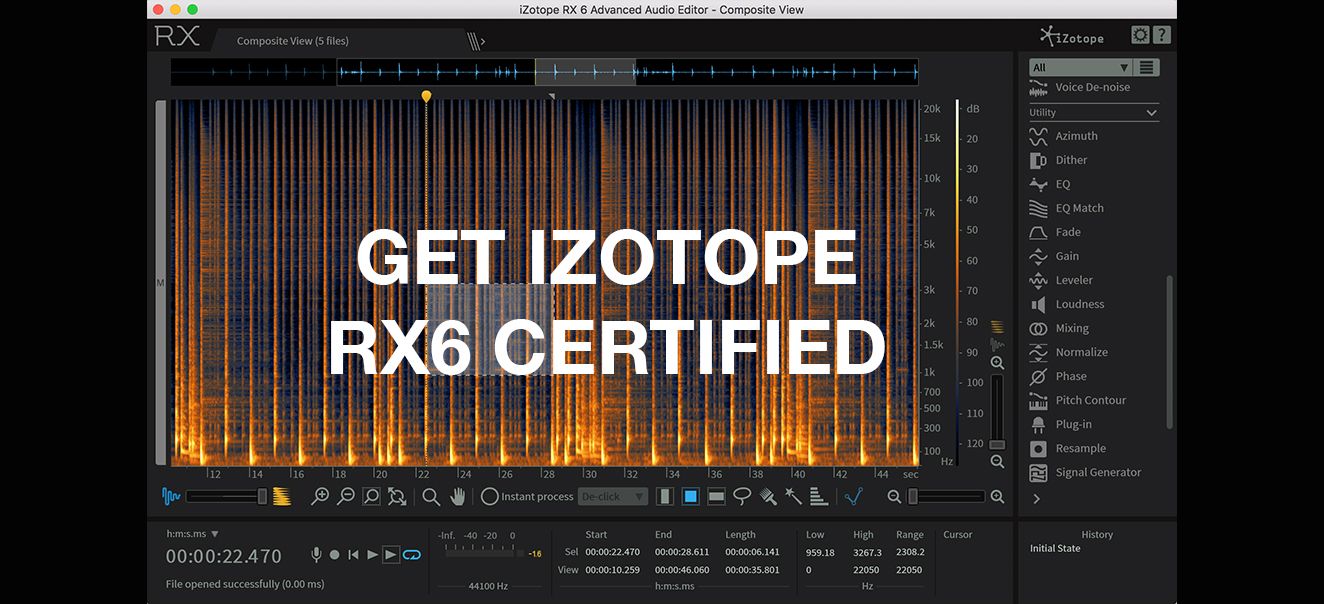
The RX interface gives users a synthesized overview of recorded audio, with the waveform in blue on top of the sound’s spectral information. In order to understand exactly what you’re fixing or editing, you need to understand that the waveform only represents the sound’s volume, whereas the spectrograph shows the sound’s energy, i.e. the different frequencies, harmonics, etc. You can process a complete file or selections of it.
A serious update to the most trusted set of tools for professional audio restoration. RX 6 Advanced is the flagship of the RX family of products, the industry standard audio repair tool that’s been used on countless albums, movies, and TV shows to restore damaged, noisy audio to pristine condition. Life is tough out there for students: tuition rates are high, student loans are looming, no matter how you look at it, going to college isn’t cheap, but you can save at Izotope Student Discount. So whip out your student ID card, type out your education email address, and you can get started reducing your price at izotope.com. Education is one of iZotope's core values, and we’re excited to equip students, faculty, and educational institutions with affordable, professional-grade, visually intuitive tools. Looking to add iZotope products to your labs or student programs? RX 6 Advanced and in 2016, and 2014, for Tachnical Acheivement in Post Production.
With RX 6 Advanced, you could change music in ways that sound perfectly natural — not a hint of having done it in software. With RX 7 Advanced, you can do the same to dialogue. In fact, RX 7 Advanced is so good at correcting imperfections in recordings, in many cases you will be able to use it as a faster and cheaper alternative to ADR.
RX 7 Advanced with Dialogue: an Alternative to ADR
I quickly realized this when I experimented with the Dialogue Contour module. When I’m recording a video tutorial for some app, I have a tendency to increase my voice’s pitch as I approach the last part, but then realize I still need to add a closing thought. Often, that turns out to be totally uncalled for — at which point I find myself with an end that sounds like it’s a question.
The only fix so far has been to start over again or record a voiceover. That’s hard to synchronize with the rest of the video without software like VocAlign or Revoice Pro. With RX 7 Advanced’s Dialogue Contour, however, I can now just lower my voice in the module, and you won’t hear that it was not recorded that way, no matter how hard you try.
With RX 7 Advanced, you can also isolate or remove dialogue or vocals from music. When in a video of a restaurant with background music, for example, the dialogue is hard to hear, you can fix that with Music Rebalance. This also allows you to create instrumental (or acapella) versions of songs by removing the vocal elements and isolating the vocals from the background music. I had my doubts about this, but after trying it out myself with different settings, I am truly astonished that it works so well. I could even isolate Cecilia Bartoli’s voice from the violins in an aria on The Salieri Album. Admittedly, with the default setting there was a tiny bit of bleeding from those violins in her voice. But a bit of experimenting with the slider delivered a pure vocal signal.
De-Reverb is a module that has been available in RX Advanced for some time, but now there’s also Dialogue De-Reverb for removing unwanted reverb from dialogue clips using an algorithm optimized for a “spoken signal”. I tried that with a recording of an announcement over the intercom by a museum guide in a cathedral. That didn’t work because the signal was 99% reverberation. However, speaking myself in a microphone in that same cathedral worked much better than I could have imagined. This module, too, could be used in place of ADR.
Surround Sound
RX 7 Advanced now also supports 7.1.2 multichannel surround sound. It lets you work on multichannel projects by toggling between all channels in one view or displaying a summed view. You can also turn individual channels on and off, summing only the ones you want to work on.
If you’re learning guitar, you also see a separate tuner button. You also find a setup button that leads to options that differ depending on the instrument you’re using. Play guitar on garageband mac. A How Did I Play? Feature answers that very question with gentle visual feedback.
Download izotope ozone 8 free. IZotope Ozone Advanced v9.0.2 CE-V.R; Building on a 17 year legacy, Ozone 9 brings balance to your music with the latest advances in machine learning for mastering audio. Log in to your iZotope account to download Ozone 9 Advanced.
Finally, iZotope’s RX 7 Advanced has assistive audio technology. This module is an intelligent repair tool that can detect noise, clipping, clicks, and more. It’s designed to speed up correction and edits. All you need to do is select the type of material (music, dialogue, other) and let RX 7 Advanced analyze the audio. The Repair Assistant then offers different suggestions for processing, using multiple modules, as well as three different intensities for each.
Your task is reduced to reviewing and auditioning, hitting Render, and letting Repair Assistant perform its magic.
I found the Repair Assistant to be really helpful with certain audio files and less so with others. Unfortunately — and as far as I could see — there’s no fixed rule to determine whether or not files are suitable to run through the Repair Assistant. The only rule I could deduce was that, if the audio has many sudden, unexpected artifacts that you can’t categorize as noise, clipping or clicks — and certainly when they sound like they’re really part of the signal you want to rescue — Repair Assistant sometimes isn’t going to cut it. Yet. I expect it to keep improving in future releases.
Insight 2
Besides RX 7, iZotope also upgraded its audio analysis tool, Insight. Insight 2 works in tandem with an iZotope plug-in, Relay, that allows you to monitor the interaction of two or more tracks or channels with the track you’re analyzing. If you insert an Insight 2 instance on the Master track, you can analyze up to eight different tracks upstream.
Insight 2 has new features as well. For example, the Intelligibility module allows you to measure whether your dialogue mix holds up in different listener environments. With the Intelligibility meter inserted on the master track, you can ensure that a dialogue is clearly understandable in low, medium and high noise environments. How those are defined remains somewhat obscure, although it does work as you’d expect. The meter requires that a Relay instance, which is inserted on a track or bus that feeds into the master output, be selected as the Source instance.
Another module that can tap into the Relay feature is the Spectrogram (2D or 3D), which provides a spectral representation of audio varying over time, allowing you to analyze individual elements within a mix. It can display data for up to eight sources simultaneously by selecting Relay instances in the source selection menu.
As with RX 7 Advanced, Insight 2 supports surround sound. For example, you can monitor the loudness of your surround sound mixes with support for Dolby Atmos 7.1.2 track configurations, but you can also monitor the surround sound field with a surround scope that shows the amplitude of surround channels. The Surround Scope not only monitors the phase relationship between neighboring audio channels, but also displays an alert when there is a negative correlation or phase cancellation taking place.
Conclusion
The RX 7 Advanced upgrade focuses on the human voice in both musical and noisy environments. It succeeds brilliantly at extracting vocal signals for you to manipulate. The vocal capabilities of RX 7 Advanced are so good that you can use RX 7 Advanced to fix dialogue instead of performing ADR.
Both RX 7 Advanced and Insight 2 now support surround sound, which makes them very suitable for cinema and video. Combined with the rather spectacular results you may expect from the machine-learning algorithms, there are now numerous cases which you don’t really need an experienced sound engineer for anymore.
In short, both apps deserve at least a closer look — a demo download is available — after which I think you will find them both must-haves.
In its time, iZotope RX3 Advanced offered the most comprehensive suite of noise-reduction software—available as a stand-alone application and as bundled plug-ins—for post-production sound, along with extensive metering, time- and pitch-shifting processors, resampling facilities and other invaluable tools. RX 4 Advanced ($1,199) adds several workflow accelerators used to comply with various loudness standards and to quickly adjust level, timbre and ambience in tracks.
I reviewed Version 4.0.1 of RX 4 Advanced (its plug-ins in AU format) using Digital Performer V. 8.06 and an 8-core Mac Pro running OS X 10.9.5. For a refresher on RX 4 Advanced’s legacy features, check out my review of RX3 Advanced in the May 2014, issue of Mix.
Streamlined Interoperability
RX’s Spectral Repair plug-in—which was a bit of a kludge in previous releases—has been discontinued, made obsolete by the new RX Connect plug-in and alternative DAW interoperability. Roughly half of leading DAWs use RX Connect as a synchronized bridge to the stand-alone RX 4 Advanced application; you first select in your DAW the audio clip you wish to process, then launch RX Connect. Other DAWs (including DP) use RX 4 as an external editor: In DP, for example, you choose the RX application as DP’s external waveform editor and then open a region in RX via DP’s Audio menu.
No matter which protocol your DAW uses, after the RX application opens you can edit the selected clip using any processing (not just Spectral Repair) it provides. Different (fast and simple) methods are used, depending on your workstation, to return the processed clip back to your DAW in perfect sync with the original clip. Because some DAWs (including Pro Tools) monopolize the system’s audio drivers, an additional plug-in dubbed RX Monitor is included to enable hearing the RX application’s output; RX Monitor interacts with your DAW like an instrument to play the RX application’s audio through the DAW’s driver.
The updated Remove Hum plug-in and module—all modules belong to the standalone application—include an Adaptive mode that analyzes your audio and automatically notches out fundamental hum-related frequencies that change over time (such as in audio for a scene that was shot in multiple locations).
The updated Time & Pitch module provides an option to run Radius processing in real time, for those tasks in which you need fast processing. The tradeoff is lower quality than with offline processing (which is still available).
New Modules
The new Leveler module uses a compressor with automatic makeup gain to curb fluctuations in signal level. Use its Target RMS slider to adjust the K-weighted RMS level of your clip. The Speed slider alters how quickly gain is adjusted. Drag the Amount slider to limit the maximum amount of gain (boost or cut) that can be applied, and raise the Noise slider to reduce potential pumping when breathing or other broadband noise occurs during gaps in dialog. You can view the gain changes that Leveler applies and edit them by dragging up and down one or more nodes at once on a graphical curve (dubbed the Clip Gain envelope; see Figure 1).
The new Loudness module automatically applies a fixed amount of gain to your entire clip (or a selected region) to instantly make it comply with a specific standard, such as BS.1770, selected from a drop-down menu. Alternatively, you can use two sliders to manually set the desired loudness (in LKFS units) and maximum true peak level of the clip. A post-limiter is automatically applied as needed to meet the selected true-peak spec.
The new EQ Match module applies static equalization to purportedly make one region’s spectral balance conform to that of another. Simply select a region (such as a phrase in a VO track) that sounds great, click Learn, select another region that sounds bad, and click Process. EQ Match lets you save spectral profiles as presets, speeding your workflow.
The Ambience Match module does for noise what EQ Match does for timbre, with one caveat: It can’t decrease the amount of ambience that already exists in a selection; it can only increase it. This is an invaluable tool for matching an ADR track’s ambience to that of the recording being replaced. You simply make a selection of the noise in the live recording, click the module’s Learn button, make a selection in your ADR track where you want the same-quality noise added, drag the Trim control to adjust the level of the ambience to be added, and click Process. Noise snapshots can be saved as custom presets.
In Post-Production Sessions
Izotope Rx 2 Free Download
I used RX 4 Advanced extensively while working on five video projects containing many dialog tracks, music and B roll. The new Leveler module gave me excellent results easily and exceedingly fast, smoothing levels no matter the track’s spectral balance. It controlled boomy-sounding peaks beautifully, often precluding the need to de-boom using multiband compression. With moderate settings—the Amount control set no higher than 4 dB—I got more natural-sounding results than when using my go-to compressors and limiters. After rendering the processing, I could mouse-drag one or more nodes at once in the automatically generated clip-gain envelope to alter Leveler’s gain changes in select spots (see Fig. 1).
The Loudness module conformed my mix to any of seven different loudness standards with just a couple of mouse clicks—a real timesaver. Using the Ambience Match module, I could capture the room tone on a dialog track and add it to another track that sounded too dead; a trim control let me adjust the level of the ambience ±6 dB without affecting the level of the dialog. Listening to the generated ambience in isolation, it was apparent it was synthesized. But in the mix, it worked inconspicuously if applied sparingly to tracks in select, short gaps.
Izotope Rx 6 Advanced Manual
I tried a couple dozen times to use EQ Match to smooth spectral balances on dialog tracks, but I always found I got better (and more predictable) results using a combination of static and dynamic equalization plug-ins.
Any editing performed on tracks in the RX application is destructive once sent back to DP (overwriting the original file everywhere it occurs in DP), a disadvantage compared to working with RX 4 Advanced’s nondestructive plug-ins. Overwritten files initially played back as—and looked like, in DP’s Sequence Editor—full-scale, broadband noise in DP; rebooting DP would always permanently restore pristine playback, but I’d sometimes also need to bounce the file to a new track to restore proper waveform display. This appears to be a bug in DP, not in the RX application.
On startup, the RX application would often arbitrarily reroute consistent output assignments to different MOTU I/O boxes or banks—sometimes to those disabled in the MOTU PCI Audio Setup utility. And I often heard distracting crackling noises and clicks while working with the application, especially while previewing a module’s processing. (An associate of mine confirmed hearing the same artifacts using RX 4 with a different system.) Thankfully, the artifacts did not print when files were overwritten back to DP; nor did they ever occur when using the RX plug-ins.
Purchase in Advance?
Izotope Rx 6 Torrent
iZotope also offers a less-expensive “standard” version, which doesn’t include the Dereverb, Deconstruct, Leveler, Loudness, EQ Match, Ambience Match, Radius RT (Time & Pitch) and Insight (metering suite) modules and plug-ins. It also lacks the center-channel extraction and azimuth alignment features for the Channel Operations module and some extra controls for Denoiser, Spectral Repair and Declick. Many of these additional features included with the Advanced version have proven to be indispensible in my work; they are well worth the extra cost.
Izotope Rx 6 Audio Editor
If you work in post-production sound, restoration or audio forensics and don’t already own RX3 Advanced, buying RX 4 Advanced is an absolute must—if only for its incredible legacy plug-ins. If you can tolerate the RX application’s intermittent routing and monitoring problems, the Leveler and Loudness modules make an upgrade from RX3 Advanced worthwhile.
Mix contributing editor Michael Cooper is a recording, mix, mastering and post-production engineer.
Izotope Rx Tutorial
TRY THIS
Izotope Rx 6 Student Login
DP can send only one region at a time to an external editor such as RX 4 Advanced. If you want to send an entire track containing non-contiguous soundbites, first make a time-range selection in DP for the entire track and select Merge Soundbites (option-shift-M).